Tree Trimming and Pruning in Franklin, TN
Pruning and trimming that respect what the tree is trying to do.
Tree trimming in Franklin, TN starts from a plain observation: most of the town’s trees don’t need to come down. They need weight taken off the right limbs, deadwood cleared before it falls on its own schedule, and room made over the roof — all with cuts the tree can actually heal.
Three reasons a tree gets pruned
Health. Dead and dying limbs come out before gravity takes them out. Rubbing branches that wound each other get separated. A crown opened up to light and moving air dries faster after rain, which is how a tree in a humid Tennessee summer wants to live.
Structure. Franklin’s silver maples and Bradford pears are famous for narrow, weakly attached forks that fail in wind. Caught early, structural pruning steers growth into a form that holds; caught late, the load on a questionable union can still be reduced so it stops being the most likely thing in the yard to break. On an open lawn the same physics is harsher, because a hardwood standing alone meets the gust with nothing upwind to slow it — which is why the heavy laterals on Brentwood lawns are the limbs most often on the reduction list.
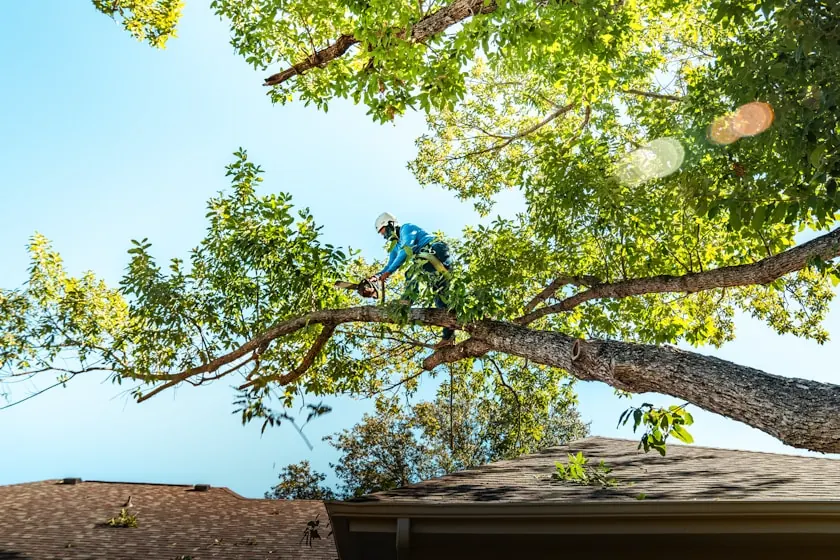
Clearance. Limbs off the shingles, clear of the gutters, away from the chimney, and up off the driveway so the delivery trucks stop grazing the same branch. Done with proper cuts back to a lateral, the clearance lasts years instead of one growing season.
The job to turn down
Topping — cutting every leader off at one arbitrary height, the way you’d shear a hedge — is the request any good crew declines. A topped tree can’t close wounds that size, so decay moves in at every cut, and the regrowth that follows is fast, dense, and barely attached: the tree comes back taller and more dangerous within a few seasons. A tree that genuinely must be shorter gets a proper crown reduction, limb by limb, back to laterals that can take over — or an honest conversation about whether it is a removal wearing a disguise.
When should trees be pruned in Middle Tennessee?
For most species, the dormant months — late fall through the end of winter — are the best window: with the canopy bare, the tree’s true architecture is finally on display, and cuts made in dormancy cost the tree least as spring begins. There are sensible exceptions. Deadwood can and should come out any day of the year. Storm-damaged limbs are pruned when the storm says so. And light touch-up trimming does no harm in summer. What to avoid is heavy pruning during the spring flush, when the tree can least spare the loss.
What a trimming estimate should spell out
Two quotes for “trimming the oak” can describe very different jobs, so it helps when the paper names the work. Look for which trees are included, what each one gets (deadwood taken out, clearance from the roof, thinning, or a crown reduction), and roughly how much of the canopy is coming off. It should also say how the cuts are made, back to a branch collar or a lateral rather than left as stubs, and whether the brush goes away on the truck as chips or stays behind in a pile. If climbing spikes are mentioned for a tree that is staying, ask why: spikes wound a living trunk and belong on removals.
How a trimming job is priced
By the tree and the work, at a free visit — a small ornamental cleaned up in an hour and a seventy-foot maple needing a full crown pass are different afternoons, and their estimates say so. Every quote is itemized by tree, so if the budget covers three of the five this year, you choose which three. Trimming quoted alongside a removal shares the trip and the cleanup, which works in your favor.
Let the free visit sort the limbs out.
The visiting firm points, you decide, and the estimate arrives itemized tree by tree.
(615) 813-4751Trimming questions
- How much of a tree can be pruned at once?
- Less than most people expect. Taking a large share of the living crown in one visit stresses the tree and sets off a flush of weak sprouts. A careful plan takes what is needed now and leaves any further reduction for a later year.
- Does a tree need trimming every year?
- Most healthy shade trees do not. Young trees gain from a light structural pass every few years while their form is still being set, and mature trees usually need attention only when deadwood shows, limbs reach the roof, or a storm leaves damage behind.
- Will the tree look bare after pruning?
- It should not. Good pruning thins and shapes from inside the crown, so the tree keeps its natural outline and still looks like itself, only lighter and more open. A tree that looks stripped or flat on top has usually been over-cut.
Find out which limbs actually need to go.
Call, or send the estimate request, and the visit goes limb by limb with you.