Hackberry Tree Removal in Franklin, TN
How to tell when the limb-dropper is done.
Hackberry tree removal in Franklin, TN comes up in a great many of the town’s older yards, since hackberries stand over so many of them and surprise more owners than any other tree. This page explains how to recognise one, why they shed limbs, which signs call for pruning, and which mean removal is the honest recommendation.
How to tell a hackberry from the other big trees
The bark gives it away. A mature hackberry wears gray bark broken into corky, warty ridges that no oak or maple in the county could be confused with. The leaves are elm-like, toothed, and lopsided at the base; the autumn crop is a scatter of small dark berries that the birds clear quickly; and the twigs often carry dense, tangled clusters called witches’ broom, which look alarming and are harmless. If the tree in question came up on its own along a fence line and simply got left, the odds are good it is a hackberry. A tree whose leaves come as several leaflets on one stalk, set in opposite pairs, is an ash instead, and what dead ash removal involves is covered separately. They volunteer readily, grow fast, and are frequently the biggest tree on a lot that nobody planted them on. That is also how a good many of them ended up as the one mature tree a builder kept in the newer neighborhoods south of Franklin, and what building around a kept tree does to it tends to surface years later as a thinning crown.
Why hackberries drop limbs
A hackberry grows big faster than it grows strong. The wood is lighter than oak, the limbs run long and horizontal, and the tree is generous with deadwood: it abandons interior branches as the canopy grows over them, and those dead limbs hang in the crown until a gust or a glaze of ice brings them down. Old wounds are the second problem. Every limb a hackberry has lost leaves an opening, decay moves into hackberry wood readily, and a tree that has been shedding for a decade often carries pockets of soft wood exactly where the next limb attaches. Add the tight, bark-included unions the species is prone to, and you have a tree whose failures arrive without the warning a homeowner expects.
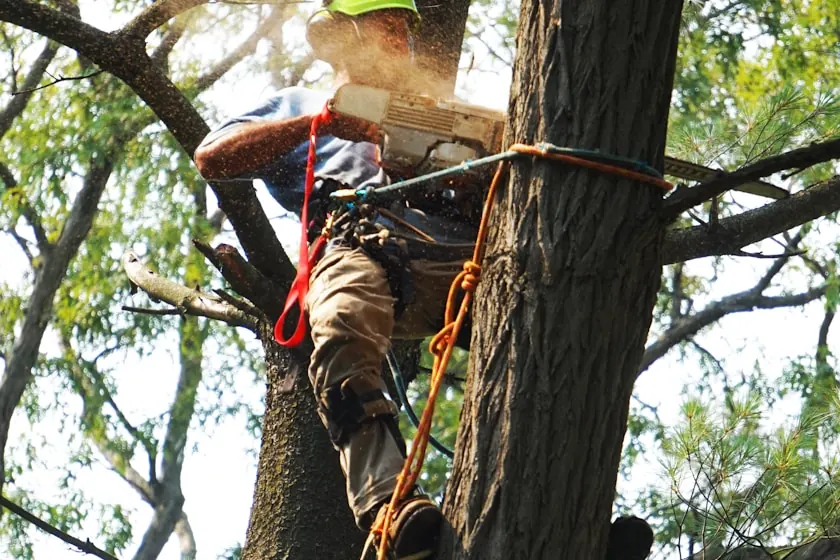
Prune it, or take it down? The signs, sorted
Most hackberry problems are pruning jobs and a few are removals. This is roughly how one gets read at the estimate visit.
| What you are seeing | What it usually means | The usual recommendation |
|---|---|---|
| Dead limbs scattered through the crown; the rest leafed out normally | Ordinary deadwood on a healthy tree | Pruning. Clear the dead wood before it clears itself. |
| One long limb over the roof or drive, alive but heavy | A lateral that has outgrown its attachment | Reduction pruning back to a strong lateral. The tree stays. |
| Limbs lost from the same side, more than once | A weak union or decay in that scaffold | Depends on the union. Reduction if the wood is sound, removal if it is not — the estimate visit checks before recommending either. |
| Fungus shelves on the trunk, a hollow you can put a hand into, sawdust at the base | Decay in the trunk or the root flare | Removal. A hollow trunk cannot be pruned into a safe one. |
| Undersized leaves across the whole crown; shoots sprouting from the base of the trunk | A tree in decline | Removal, scheduled for a calm week while the tree is still safe to climb. |
| A new lean, cracked bark at the base, soil lifted on one side | The root plate is failing | Treat it as urgent: keep people well back from it and telephone or send the request form today. |
What hackberry removal costs in Franklin
Franklin’s hackberries mostly live in the large-hardwood row. A typical removal in this market runs about $850; a mature hackberry with limbs over the house, roped down section by section, runs $850 to $2,000; and the tallest ones, past eighty feet or needing a crane, reach $1,200 to $2,500 and up. A hackberry that has already come down on a roof in a storm bills at two to three times the standard rate, for the reasons the storm and ice page explains. Every estimate is free, itemized, and specific to the tree; the pricing guide covers what moves a tree inside those ranges. Pruning is priced tree by tree at the same free visit and appears on the estimate as its own line.
If it stays: pruning a hackberry properly
A hackberry that is sound at the trunk and the main unions is worth keeping, and the pruning that keeps it is specific. Dead wood comes out first, all of it, because dead hackberry limbs are the ones that fall on calm days. Long laterals over the roof are shortened back to a lateral that can take over, which removes the leverage without leaving stubs. And nothing gets topped: a topped hackberry answers with a thicket of fast, weakly attached shoots that become next decade’s limb-droppers. The dormant months are the right time for most of this work; the pruning page explains the reasoning.
The stump has opinions
Hackberry stumps sprout. Leave one in the lawn and it will push up shoots from the stump and the roots for seasons afterward. Grinding the stump the day the tree comes down ends that, and it costs least then, with the grinder already at the curb. The stump removal page covers what grinding leaves behind and the three ways to finish the spot.
Hackberry questions we hear
- Is a hackberry a bad tree to have near the house?
- Not by itself. A healthy hackberry with its dead wood kept clear and its long limbs kept in check is a fine shade tree, and plenty of Franklin’s do exactly that job. It becomes a problem when it is left alone for twenty years over a roof, which is the tree most hackberry worries are about.
- Can a hackberry that has already dropped a big limb be saved?
- Often, yes. One lost limb with a clean wound on an otherwise sound tree is a pruning-and-watch situation, not a removal. The estimate visit looks at the wound, the union it came from, and the wood around it; if that wood is sound, the recommendation is to reduce the remaining weight and keep the tree.
- What does it cost to remove a hackberry in Franklin?
- About $850 for a typical tree, $850 to $2,000 for a large one over structures, and $1,200 to $2,500 or more for a hackberry past eighty feet or one that needs a crane. The estimate is free and itemized, and stump grinding is listed separately so you decide whether to add it.
Get the hackberry read.
Call and describe it, or send the estimate request, and the firm it is forwarded to will come read the tree with you. The look is free and the estimate is itemized.